I am reading a new book. Yes, I am reading a book--a real book, one that was written for adults. Even more importantly, I am reading this book on my own. I am reading it because I want to--not because someone has told me to. I realized on the way back from spring break that it was inexcusable to give up reading because school was starting. The educator in me cringes at the thought of not having time to independently read and learn through books because of a prescribed curriculum. The truth is, I have learned more in 86 pages on this book than I have learned in 3 weeks of class thus far. So I am reading instead of homework. I will get to homework (and Relay, cleaning, laundry, pre-institute work, packing, cooking) eventually, but for now I am reading and learning.
I am about 1/3 of the way into Letters to a Young Teacher by Jonathan Kozol. Kozol uses a letter format to give his views and commentary on teaching. His letters are a correspondence (integrated with personal experience) that show a mentoring relationship he has with a young teacher in an urban Boston school district. The book is filled with advice, anecdotes, and commentary. I LOVE it. While I do not agree with every word he writes, I share his basic perspective and feel that his letters and wisdom will be invaluable as I begin teaching.
Chapter 8: The Uses of "Diversity" brought up a poignant point about education. An ugly truth that we all know, but it is easier to ignore. He argues that most schools are not any more diverse than they were when Dr. King was protesting segregation. Personally, I was lucky enough to be placed in a school that was very diverse, but looking at some of my other placements, this was not the norm. In my preschool placement in a suburb of Cincinnati, all of my students were white. In my work-study preschool in Avondale near OTR, my students were all black. Less than 15 miles apart, my students lived and had vastly different lives and school experiences. Seperate and unequal by geography, but still only 15 miles apart. It really is devastating to look at how far away fifteen miles really is. How can we teach diversity authentically when our children really have not experienced it? Is the "message" of diversity really enough? As a teacher, I likely cannot change the school composition and boundaries for my students, but my hope is that I can explore diversity with them beyond a surface level understanding. My students at Fairview showed me how capable children are of understanding social issues and accepting and celebrating children from other backgrounds. My only hope is that I can do the same in a different setting with my own classroom of students.
In Kozol's words teachers have a choice on how to teach diversity:
"Education, no matter what the rulebooks say, is never absolutely neutral. We either teach our children it's okay to write and talk about the things they think to be the truth or else we teach them that it's more acceptable to silence their beliefs, or even not to have beliefs but to settle for official truths that someone else has carefully prepared for them." (p 86).
Wednesday, April 13, 2011


Monday, April 11, 2011
A Different Perspective. How long is 2 years?
So I read this guest blog post in the NYT tonight. It is a 3 part series that discusses one of the most controversial parts of the Teach For America program: the two year commitment. This is an issue I can see both sides of. There is something to be said for new energy, but there is also a part of me that knows that teaching cannot be mastered overnight. It takes time to learn and build teaching skills. The 2 year commitment was not a factor for me b/c I plan to spend the rest of my life in the field of education, but I realize that this is not everyone's ideal pathway. I personally think it is better to have people in all areas of society who have had teaching experience. Why? I believe that it is difficult to understand the problems with our education system and the challenges of being an educator until you have been one! I really believe this out of any career, but I think that it is particularly important b/c so many people believe they know all about being a teacher. Let me tell you, being a student does not mean you know what it is like to be a teacher. The same goes for parents (not that I know this personally).Just because your children go to school does not mean that you understand the complexities of being a classroom teacher. Education is a common experience in our society and a much less complex social issue than war, taxes, and spending, thus people feel the need to comment on it. Walk a mile in our shoes please :)
Now that I have gone on a really long tangent, why I really brought the series up is more personal. It was not until reading them that I realized I might be making a permanent move to Nashville. Freak out moment! Major freak out moment. I think that up until this point I have been relying on the "its only 2 years" idea of a temporary placement rather than a major life change and career move. I think I have been holding on to the idea that in 2 years I can return to Cincinnati and that it will be the same city and experience that it is now for me. Reality check. Two years is a long time. I am leaving a lot behind and so many things can change. Right now I am terrified. I think it is about time I begin to embrace it.

Now that I have gone on a really long tangent, why I really brought the series up is more personal. It was not until reading them that I realized I might be making a permanent move to Nashville. Freak out moment! Major freak out moment. I think that up until this point I have been relying on the "its only 2 years" idea of a temporary placement rather than a major life change and career move. I think I have been holding on to the idea that in 2 years I can return to Cincinnati and that it will be the same city and experience that it is now for me. Reality check. Two years is a long time. I am leaving a lot behind and so many things can change. Right now I am terrified. I think it is about time I begin to embrace it.

Saturday, April 9, 2011
Join me and "Click to Give"
Hey everyone,
I spend about 2 minutes every day to "Click to Give" at the following collection of sites:
http://www.thehungersite.com
http://www.thebreastcancersite.com
http://www.theanimalrescuesite.com
http://www.theveteranssite.com
http://thechildhealthsite.com
http://www.theliteracysite.com
http://www.therainforestsite.com
I get an email daily from "the literacy site" and it takes me to a webpage in which I can click a button and help give books to children in need. The best part is that it is all free. I click for free and help the organizations I care about. How easy is that? The webpage is set up so their is tabs at the top of the page and by going to any one of these sites will allow me to fight world hunger, breast cancer, support rescued animals, veterans, children's health, literacy, and save the rainforest. It amazes me that MORE people do not click daily!
Each click supports different charities associated with the cause. I want to point out on of the literacy organizations that I will hopefully be able to connect with next year in Nashville called First Book. This program offers support to educators and community program to get books in the hands of children who need it the most. The program has donated over 80 million books to children in need. There are 2 levels of donation from the organization: if 50% of the children in your program come from low-income families, you have access to books 50-90% off of the retail price. If 80% or more of the children in your program come from low-income families, you may be eligible to get books for free!
Have I convinced you yet? I hope so! Ready, set, go click!
I spend about 2 minutes every day to "Click to Give" at the following collection of sites:
http://www.thehungersite.com
http://www.thebreastcancersite.com
http://www.theanimalrescuesite.com
http://www.theveteranssite.com
http://thechildhealthsite.com
http://www.theliteracysite.com
http://www.therainforestsite.com
I get an email daily from "the literacy site" and it takes me to a webpage in which I can click a button and help give books to children in need. The best part is that it is all free. I click for free and help the organizations I care about. How easy is that? The webpage is set up so their is tabs at the top of the page and by going to any one of these sites will allow me to fight world hunger, breast cancer, support rescued animals, veterans, children's health, literacy, and save the rainforest. It amazes me that MORE people do not click daily!
Each click supports different charities associated with the cause. I want to point out on of the literacy organizations that I will hopefully be able to connect with next year in Nashville called First Book. This program offers support to educators and community program to get books in the hands of children who need it the most. The program has donated over 80 million books to children in need. There are 2 levels of donation from the organization: if 50% of the children in your program come from low-income families, you have access to books 50-90% off of the retail price. If 80% or more of the children in your program come from low-income families, you may be eligible to get books for free!
Have I convinced you yet? I hope so! Ready, set, go click!
Thursday, April 7, 2011
"We need to give them privacy"
I went back to visit my class today and was blown away by the excitement our aquariums has generated. My mentor teacher told me that earlier in the week the Froggers saw a live birth in one of the tanks. Now, my students are obsessed with it happening again. The blue and orange tables were convinced that their fish were having a baby. When it didn't come...
"Guys, we need to give them privacy!"
"Back up, we need to give them privacy. You wouldn't want to have people watching if YOU were having a baby."
"Miss Prinzo, can you tell them to stop looking at the aquarium...the fish need privacy!"
...it felt good to be back :)
"Guys, we need to give them privacy!"
"Back up, we need to give them privacy. You wouldn't want to have people watching if YOU were having a baby."
"Miss Prinzo, can you tell them to stop looking at the aquarium...the fish need privacy!"
...it felt good to be back :)
Friday, April 1, 2011
Money Mania Part 2
I am sure you were on the edge of your seat, waiting anxiously to find out what happened with the rest of my Money unit. So here it is! Just a reminder, all of the worksheets I created can be found, downloaded, and edited at this link: https://docs.google.com/document/d/10su9dLXoWZ864pu-n_W61mFS9Cx9H_w1uAWTdlueI6E/edit?hl=en&authkey=CLGf3q0I
A Strategy for Counting Money
I was initially very frustrated when thinking about how to teach money. My class had not covered double digit addition yet not had they covered addition of more than three digits, so how was I going to teach them how to add money??? I found this strategy through the TFA resource exchange and it worked really well for my students. The strategy shows students how to count money by drawing lines or "legs" based on how many "fives" each coin has. A quarter gets 5 lines (two arms, to legs, and a ponytail...just like Washington!), a dime gets 2 lines (two legs), and a nickel gets 1 line (like a lollipop). After you label the coin, then count by fives. Each time you count make a little cross over the coin (so they can keep track of where they were). After adding all the silver coins, count on with the pennies. I was amazed at how well the students responded to this method. We practiced it with plastic coins and our white boards first then translated it to paper images of coins.
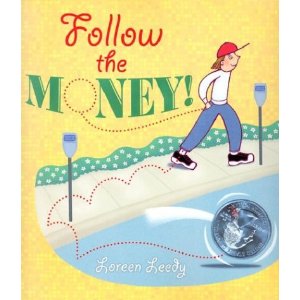
After counting money, we practiced counting money in story problems. This reinforced the meaning of money away from the strategy. I read Lorreen Leedy's Follow the Money to my students. The book is a little bit challenging, and parts were above many of them, but they really seemed to enjoy it and the concept of the book, that money is of a certain value and exchanged for a certain value, was simple enough for them to understand. The has great illustrations and helped us discuss some of the features of money more in depth.


I have to admit, I was REALLY proud of my students during the unit and after the assessment. They went well above grade level standards in this unit! I couldn't be prouder!
A Strategy for Counting Money
I was initially very frustrated when thinking about how to teach money. My class had not covered double digit addition yet not had they covered addition of more than three digits, so how was I going to teach them how to add money??? I found this strategy through the TFA resource exchange and it worked really well for my students. The strategy shows students how to count money by drawing lines or "legs" based on how many "fives" each coin has. A quarter gets 5 lines (two arms, to legs, and a ponytail...just like Washington!), a dime gets 2 lines (two legs), and a nickel gets 1 line (like a lollipop). After you label the coin, then count by fives. Each time you count make a little cross over the coin (so they can keep track of where they were). After adding all the silver coins, count on with the pennies. I was amazed at how well the students responded to this method. We practiced it with plastic coins and our white boards first then translated it to paper images of coins.
After counting money, we practiced counting money in story problems. This reinforced the meaning of money away from the strategy. I read Lorreen Leedy's Follow the Money to my students. The book is a little bit challenging, and parts were above many of them, but they really seemed to enjoy it and the concept of the book, that money is of a certain value and exchanged for a certain value, was simple enough for them to understand. The has great illustrations and helped us discuss some of the features of money more in depth.
After reading the book, we walked through a series of story problems I created to reinforce that you pay money for something. I would tell the children to put X amount of coins on their board and count them. After we counted them, I would start a story and we would take money off of the board for each part of the story and recount. I also always made sure that the children were taking off the "best" way to make change (ex. for ten cents I would have them pull a dime over 2 nickels). I explained that when you make change or pay for something you typically want to use the fewest amount of coins possible. For example:
Miss Prinzo has 2 quarters, 2 dimes, 2 nickels, and 4 pennies. How much money does she have?
Miss Prinzo goes to the store and buys a pack of stickers for 30 cents. How much money does she have left? (we did this as a group so I would ask the children how we should make 30 cents, remove it from their board, and recount it for each step)
Miss Prinzo buys a notebook to put her stickers in. It costs 37 cents. How much money does she have left?
Miss Prinzo wants to buy an ice cream cone. It costs 50 cents. Can she buy it? Why or why not? How much more money does she need.
After we practiced as a group several times, I had the children work in pairs with manipulatives (coins), individually with manipulatives, and in pairs without manipulatives, and individually without manipulatives. Children who finished early were given the challenge of writing their own money stories (a document of this is in the link above). I picked one of these problems each day to write on chart paper and work through during our introduction time with whole group. This was an amazing motivation for the students. So much so that I ended up putting a few blank stories in our writing center for children to keep practicing with. 


Student work samples. The first image is the "money story frame" ( a brilliant story about Miss Prinzo and her trip to Walmart complete with the "Save Money, Live Better" logo) and the second image was of our first student authored problem.
The assessment for my unit was accomplished over 2 days. During day one each student shopped at FroggerMart. This was a HUGE hit with my students. They were asked to pay for 2-4 items. With each item, they had to make correct change to pay me (or tell me why they couldn't) and then figure out how much they had left to spend and still could afford. The students did a great job with this...only a few needed teacher intervention for the task. This was definitely an activity that would need a few adult volunteers. We did it during half group time (only 10 students in the room) with two adults and it still took forever! I tried to group the students by the expected pace and ability level and eventually did 5 students at a time instead of the 3 I had intended.


Tuesday, March 15, 2011
Money Mania Part 1
Money was my second big math unit of lead teaching. My mentor teacher pre-warned me that money is often something that the students either really get or don't get, especially at first. I wanted all of my student to get money, but I was not satisfied with many of the resources I found. As a result I ended up making several resources I thought I would share them with everyone in blogland. Hopefully it will be useful to others teaching a money unit in the future.
Here is the link: Money Unit. This should take you to a collection of the unit in Google Docs. I believe you can download the documents into word and make any changes to them you would like.
Here is an overview of the unit:
- Identification Pre-Assessment. A checklist to use to see which children in your class can identify the amount and value of each coin. I am so glad I did this step (well, asked a parent helper to do this step) because I immediately found out that much of the initial material for the unit could be turned into a quick review, rather than the several days I had planned. As the identification is a major part of our standard I was able to repeat this step with the children who could not identify coins in the pre-assesment as quick checks throughout the unit.
- "That's a lot of Change" coin counting song. I made up a short song for the coins. It is attached as a big book that I used daily to review the coins with my students and as a individual counting book that my students filled in and kept in their desk folders in the beginning of the unit to help identify coins. I can't for the life of me remember what the tune of the song really is, but here are the words:


Here is the link: Money Unit. This should take you to a collection of the unit in Google Docs. I believe you can download the documents into word and make any changes to them you would like.
Here is an overview of the unit:
- Identification Pre-Assessment. A checklist to use to see which children in your class can identify the amount and value of each coin. I am so glad I did this step (well, asked a parent helper to do this step) because I immediately found out that much of the initial material for the unit could be turned into a quick review, rather than the several days I had planned. As the identification is a major part of our standard I was able to repeat this step with the children who could not identify coins in the pre-assesment as quick checks throughout the unit.
- "That's a lot of Change" coin counting song. I made up a short song for the coins. It is attached as a big book that I used daily to review the coins with my students and as a individual counting book that my students filled in and kept in their desk folders in the beginning of the unit to help identify coins. I can't for the life of me remember what the tune of the song really is, but here are the words:
My brown penny is worth 1¢.
My brown penny is worth 1¢.
My brown penny is worth 1¢.
That’s not a lot of change!
My fat nickel is worth 5¢.
My fat nickel is worth 5¢.
My fat nickel is worth 5¢.
That’s not a lot of change!
My tiny dime is worth 10¢.
My tiny dime is worth 10¢.
My tiny dime is worth 10¢.
That’s not a lot of change!
My big quarter is worth 25¢.
My big quarter is worth 25¢.
My big quarter is worth 25¢.
That’s not a lot of change!
In my pocket I have one penny.
In my pocket I have one nickel.
In my pocket I have one dime.
In my pocket I have one quarter.
That’s A LOT of change!
Note: After the first day, we changed the last part of the song to "In my pocket I have 41 cents". This is because on the first day I gave the children a challenge to figure out how much change they would have if they had one of each coin. I let them work together and observed them. This was a great way to see which of my students were familiar with counting money and what kind of strategies they used.
Coin Bingo- My students love Bingo, or in this game "MONEY", and it is a great way to practice identification.
A Dollar for Penny- This is an easy read book that is about a little girl who has a lemonade stand. Each customer gives her a different coin and eventually she has one dollar. We read the book and put up the coins and counted how much money she was collecting as she read.

Race to 100 (or Race to 1$)-We played this simple game on hundreds day....how perfect could this unit have aligned? To play the game each child was given a sorting mat (a column for pennies, nickels, dimes, and quarters) and play money (6 pennies, 3 nickels, 3 dimes, and 5 quarters) and a die (dice?). As they rolled the die they put that amount of pennies onto their board. The trick to the game was that there was not very many pennies so they were forced to trade up as they got closer to a dollar. This was tricky for some of the students, but the more they played the easier the conversions were for them to make. The children played in partners and the first one to get to 100 cents won the game (but we encouraged them to keep playing).
Count by fives dance- I modified this idea from a TFA corps member on our resource site. It is a fun way to practice counting by fives. It was used as preparation for counting coins in the second week of our unit. As we counted by fives we would do motions similar to those in the Macarena. Instead of swirling our hips we put our hand on our knees, feet, knees again, crouched down on 95 and jumped up and shouted 100.
Caps for Sale math- We read the classic story Caps for Sale. After we read the book we drew pictures to figure out how much the peddler would have earned if he sold all of his caps (remember, "Caps for sale! Caps for sale! Fifty cents a cap!"
I also gave the children a worksheet with word problems to see how much money he would earn if they caps cost different amounts or if he sold different amounts of caps. This worksheet is linked to in the money unit link above. They did this in partners because I had not yet taught them formally how to count change. We had practiced some strategies, but there had not been a formal lesson. It was amazing to hear the strategies the children used...especially after we had played the race to 100 game. You will also notice on this page, and many other pages from the unit I have listed challenge problems. The way I set up challenge problems is that the children must show me that they have all of the correct answers on the original side of the paper (we give immediate feedback in math b/c it is done in half group so I only have ten students to check). Once they have gotten all of the problems right on the first side they can work on the challenge problems. This is a huge motivator. Sometimes I will give them a piece of candy or a sticker for getting all of the challenge problems right, but the word "challenge" is usually motivation enough for them. If they do not finish they can keep it to work on when they finish other activities, during center time, or as morning work the next day (or they do not have to finish them at all). I also let them take the papers home and work with their families on it. If they bring it back the next day and there was a treat attached, they can get it the next morning.

Alright...there is week one of our money unit...it is past my bed time, but the rest of the unit is coming soon!
Tuesday, March 8, 2011
BANG!
One of the few things I learned from my Kindergarten practicum (other than how not to treat students) was a game called BANG. It is a really simple game that helps children practice sight words (and I taught the children how to play it using math facts). In the game you have some sort of flash cards. Take a few of the cards (about one for every 5 or 6 cards) and put a small sticker on it. After that you are ready to play!
The rules of the game are simple: You move in a circle. Each child is shown a card. If they say the sight word (or give the fact etc.) they keep the card. If they get it wrong, the next person gets a try until the card is taken. When you get to a card that has a sticker, you get a "bang". If you are right, then you can take a card from another players pile--but only if you can say the word/ give the answer. Play until the cards run out. The player with the most cards win.
Fair warning...you may want to change the name of the game (or get ready to hold in your adult humor)... because you will her things like...
"I am going to bang you!"
"Stop banging me!"
"She is banging me again!"
The rules of the game are simple: You move in a circle. Each child is shown a card. If they say the sight word (or give the fact etc.) they keep the card. If they get it wrong, the next person gets a try until the card is taken. When you get to a card that has a sticker, you get a "bang". If you are right, then you can take a card from another players pile--but only if you can say the word/ give the answer. Play until the cards run out. The player with the most cards win.
Fair warning...you may want to change the name of the game (or get ready to hold in your adult humor)... because you will her things like...
"I am going to bang you!"
"Stop banging me!"
"She is banging me again!"
Subscribe to:
Posts (Atom)